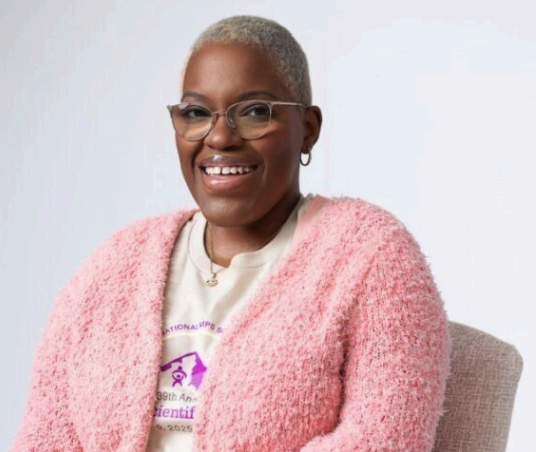
Kelley grew up in Jersey City, where her childhood was shaped by both anxiety and resilience. She remembers feeling different early on, living with a noticeable disability and often becoming the target of bullying at school. Moving between states, including a period in Alabama during high school, only added to the challenges.
After high school, Kelley enrolled at Jersey City University. She began as a history major before switching to English, but personal circumstances meant she wasn’t able to complete her degree. Even so, she found other ways to keep learning and growing, building a life centered on creativity, humor, and, eventually, the family she began to build.
Her family began in an unlikely place: Facebook. Kelley, who had skipped her senior prom the year before, connected with a former acquaintance, Branden, who needed a prom date. Their friendship quickly blossomed into something more, and they’ve been together since 2009. Now in their thirties, they are raising their daughter, Jorden, who is 14, and Kelley is grateful for the love and support Branden has given her, especially as she’s navigated health challenges.
“Branden has been such a huge support for me,” she says. “I just don’t know where I would be without that guy.” Their household is filled with laughter, karaoke nights, board games, and the antics of their black pug, Kobe—named after basketball legend Kobe Bryant, though Kelley jokes she has no interest in sports.
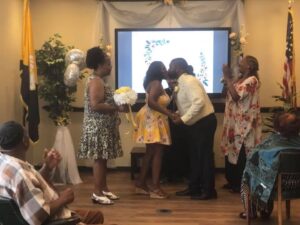
Kelley and Branden at their wedding.
Through all of this, though, Kelley carried the weight of unexplained medical problems.
“It was a very long road,” she recalls. “I’ve had valve replacement done twice. I’ve had my cervical spine fused. When I was younger, it felt like a lot of gaslighting. My eyesight is pretty bad, and I could see something was up with my hands, but because I wasn’t in pain, the doctors were telling me that I was fine. Last year, I really started believing that I just had bad luck, and anything that could go wrong would.”
The turning point came during what was supposed to be a routine eye exam. Her optometrist noticed something unusual and insisted that Kelley see an ophthalmologist. Scans revealed that the issue wasn’t with her eyes but with her cervical spine, and a neurologist soon explained that the tightness there could eventually lead to paralysis. So, Kelley underwent a spinal fusion, determined once again to face whatever came her way.
After the surgery, she decided to look for answers in a different place.
“I put all my medical records into ChatGPT, just to see if it might give me some ideas,” Kelley says. “It told me that I should seek out a geneticist—I was shocked, that response felt so out of left field!” But when she looked more closely at her records, she realized the radiologist had already suspected MPS.
That same radiologist suggested that Kelley see a geneticist, who confirmed the suspicion.
“I checked almost every day for my results after that visit, and finally, they came back positive for attenuated MPS I,” Kelley says. “My family was sad when I told them, because they had never been able to help me pinpoint what was going on, but I wasn’t upset. I felt relieved. I felt like, for the first time, that I wasn’t crazy. As I looked more at MPS and everything it affects, it was this feeling of ‘Yes, okay, yes, everything makes sense now!’”
For Kelley, receiving her diagnosis was life-changing—not only for the clarity it provided, but for the connections it opened. “I sort of think my diagnosis was a blessing,” she explains. “A rare diagnosis is never easy, but it allowed me to connect to the National MPS Society and to a community of people I never knew I needed in my life. I’m so grateful for that.” Through the National MPS Society, Kelley found support from the Pathways team, including Leslie, and a sense of belonging she had never experienced before.
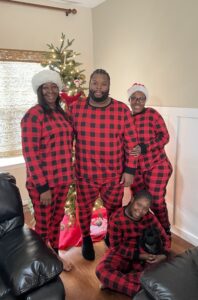
Kelley and her family.
With her diagnosis and new community, Kelley felt empowered to share her story more widely. She began posting online, using her experiences to help others, especially other Black individuals with MPS who may feel unseen. Her mix of authenticity, strength, and humor shines through in her content, a balance she admits is important for her own mental health, too.
At home, Kelley balances her advocacy with moments of calm and creativity. She spends her days doing puzzles, diamond painting, and crafting to ease her anxiety. She and Branden share quiet evenings watching TV—usually reruns of Scrubs, Survivor, or Rick and Morty—and dreaming about the future. She is excited to begin treatment, with the hope of moving to an at-home treatment model soon, and she looks forward to a trip to Las Vegas in the near future.
Reflecting on her journey, Kelley emphasizes the strength and humor that guide her. “I want people to know that I am strong. I go through so many things, so many hardships, and sometimes I have to remind myself and others how strong I am. I’m determined, too—I’m always trying to solve whatever challenges I come up against.”
And she never forgets the role of laughter. “Also, I’m hilarious. I take nothing serious; life is already so scary, so why not laugh about it?”
If you’d like to follow along on Kelley’s journey, you can follow her on TikTok and Instagram.